U.S. Citizenship Oath Ceremony 2026: Form N-445, What to Bring & Next Steps

Your naturalization interview may be over and your Form N-400 may be approved, but you are not a U.S. citizen yet. For most applicants, citizenship becomes final only when you take the Oath of Allegiance at a naturalization ceremony.
The ceremony itself is usually straightforward, but the days before it create a surprising number of practical questions: What is Form N-445? What do you bring? What happens if you traveled after your interview? Do you surrender your Green Card? Can family attend? What if you requested a name change? When can you apply for a U.S. passport?
Quick answer: follow the instructions on your Form N-445 exactly, answer its questionnaire truthfully for the period after your naturalization interview, bring the documents listed on the notice, check in with USCIS, surrender your Permanent Resident Card when required, take the Oath of Allegiance, and carefully review your Certificate of Naturalization before leaving if possible.
Last verified: August 21, 2026. Ceremony procedures can vary by USCIS field office, court, venue, and individual case. Your own Form N-445 and any instructions from USCIS or the court control over a general guide.
What is the U.S. citizenship oath ceremony?
The naturalization ceremony is the final legal step for most people becoming U.S. citizens through Form N-400. USCIS explains that an applicant is not a U.S. citizen merely because the naturalization interview went well or because the application was recommended for approval. Citizenship generally begins after the applicant takes the Oath of Allegiance.
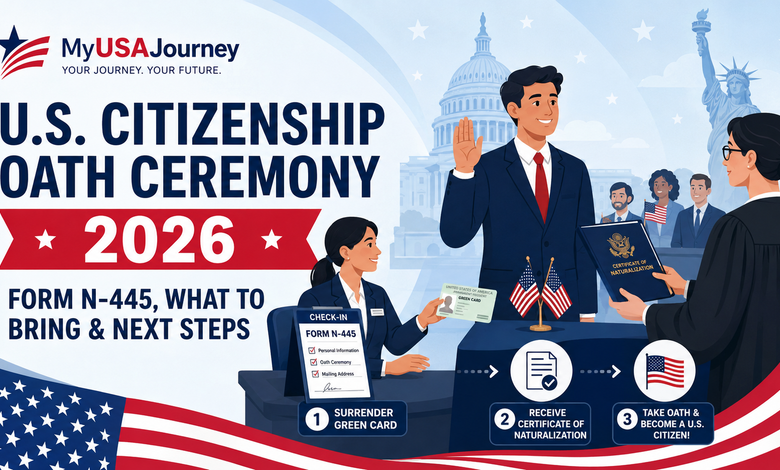
At an administrative ceremony, USCIS personnel normally check applicants in, review the answers on Form N-445, collect required immigration documents, administer the Oath of Allegiance, and issue the Certificate of Naturalization. Some ceremonies are small and held at a USCIS office. Others may take place in federal courts, government buildings, parks, museums, universities, or other approved venues.
If you are still waiting for a decision after the interview, start with our Form N-652 and post-interview decisions guide. If your case has already been approved and you have received an oath notice, this guide focuses on what happens next.
What is Form N-445?
Form N-445 is the Notice of Naturalization Oath Ceremony. It tells you when and where to appear and provides instructions for the ceremony. It also contains a questionnaire about events that may have happened after your naturalization interview.
The questionnaire matters because USCIS must confirm that you remain eligible for naturalization up to the time you take the oath. Approval at the interview does not give you permission to ignore later events. A new arrest, extended trip, change in marital situation in a marriage-based case, or another material development can still matter.
Do not complete the N-445 from memory weeks in advance and then forget about it. Read the instructions on your actual notice and answer according to the period it specifies. If something happened after you completed the form but before the ceremony, tell the USCIS officer during check-in rather than hiding it.
What kinds of changes does USCIS review before the oath?
The exact wording and layout of Form N-445 can change, so use your own notice rather than an old screenshot from the internet. In general, the final review is designed to identify post-interview events that could affect eligibility or require clarification.
- Travel outside the United States after the naturalization interview;
- Arrests, citations, charges, or other law-enforcement encounters;
- Changes in marital status or living arrangements when they are relevant to the naturalization basis;
- New claims, statements, or conduct that could affect good moral character or eligibility;
- Changes involving military-service obligations or other oath-related issues;
- Any other development USCIS specifically asks about on the current notice.
A “yes” answer does not automatically mean your ceremony will be canceled. It means USCIS may need to ask questions or review documents before allowing you to take the oath. The worst strategy is to hide a material event because you are afraid it could delay the ceremony.
If a post-interview event involves an arrest, criminal charge, immigration issue, tax issue, false claim to citizenship, voting issue, or another legally sensitive matter, consider obtaining advice from a licensed U.S. immigration attorney before the ceremony.
What should you bring to the citizenship oath ceremony?
Your Form N-445 is the most important checklist because USCIS can request documents based on your case. Do not replace the instructions on the notice with a generic online list.
| Item | Why it matters |
|---|---|
| Form N-445 | Your ceremony notice and questionnaire; complete it as instructed and bring it with you. |
| Permanent Resident Card (Green Card) | USCIS normally collects it at check-in because you will no longer need proof of permanent residence after naturalization. |
| USCIS-issued travel documents | Bring reentry permits, refugee travel documents, or other USCIS-issued documents if the notice instructs you to surrender them. |
| Other documents listed on your notice | Your case may have individualized requirements. Follow the notice exactly. |
| Evidence relating to a new post-interview event | If something changed, bringing relevant records may help USCIS review the issue efficiently. |
| Identification | Bring any identification specifically requested by the notice or venue instructions. |
If your Green Card was lost, stolen, or destroyed, do not assume you cannot naturalize. USCIS policy allows the surrender requirement to be handled differently when the applicant establishes that the card is unavailable. Follow your notice and be prepared to explain what happened.
For a broader preparation list covering the entire N-400 process, see our naturalization documents checklist.
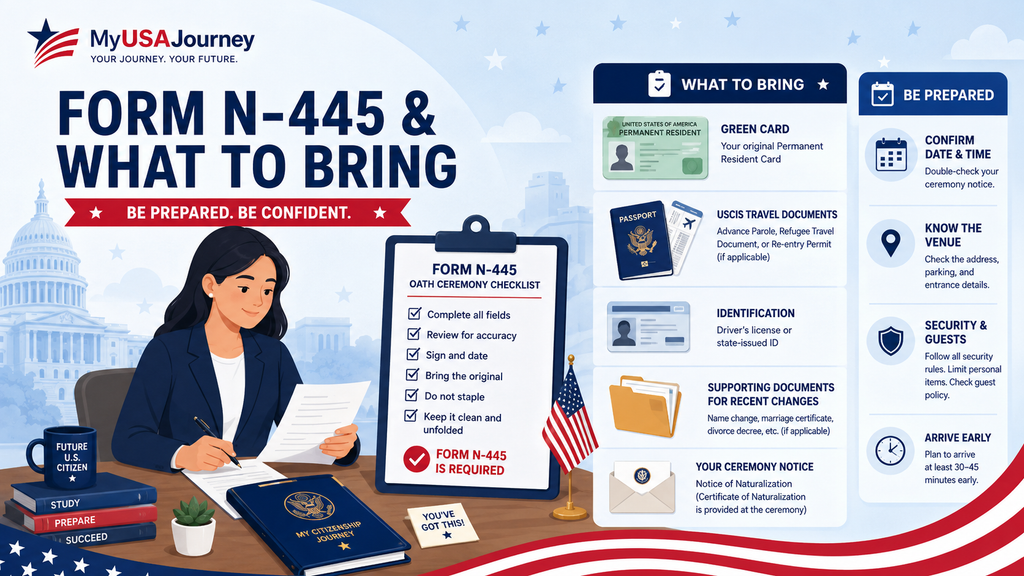
A practical oath-ceremony checklist
- Read every page of Form N-445.
- Confirm the date, time, address, parking, security, and venue instructions.
- Answer the N-445 questionnaire truthfully according to its instructions.
- Review everything that changed since your naturalization interview.
- Gather your Green Card and any USCIS-issued travel documents you are instructed to bring.
- Bring supporting documents for any new issue that may need explanation.
- Check whether guests are permitted and whether the venue has seating or security restrictions.
- Arrive with enough time for security and USCIS check-in.
- Do not make international travel plans that assume you will still use your Green Card after naturalization.
- Plan to inspect your Certificate of Naturalization carefully before leaving.
Can you take the oath on the same day as your interview?
Sometimes, but it is not guaranteed. USCIS states that in limited circumstances an applicant may be able to participate in an oath ceremony on the same day as the naturalization interview.
Whether same-day naturalization is available depends on factors such as the field office, ceremony schedule, whether the application can be approved immediately, and whether a judicial ceremony is required. Do not book travel or make legal commitments based on the assumption that you will become a citizen the day of your interview.
If same-day oath is not available, USCIS normally schedules a later ceremony and provides Form N-445 with the date, time, and location.
How long after the citizenship interview is the oath ceremony?
There is no universal number of days that applies to every field office. Some approved applicants receive a ceremony date quickly, while others wait longer because of local ceremony calendars, court schedules, requested name changes, unresolved updates, or other case-specific factors.
Recent applicants also report very different timelines by field office, which is why anecdotal timelines should not be treated as a promise. The safest approach is to monitor your USCIS online account, read every notice, and avoid comparing your case too literally with someone in another city.
If your case remains in a post-interview status for an unusually long period, distinguish between waiting for an N-400 decision and waiting for a ceremony after approval. They are not the same procedural situation.
What happens when you arrive at the oath ceremony?
The exact order varies by venue, but an administrative USCIS ceremony generally begins with check-in. USCIS personnel review your Form N-445 responses, update information if necessary, and verify that you remain eligible to naturalize.
USCIS then collects documents that you are required to surrender, including the Permanent Resident Card and applicable USCIS-issued travel documents. Once check-in is complete, applicants are seated for the formal program.
USCIS policy describes a ceremony program that can include welcoming remarks, the national anthem, recognition of the countries represented by new citizens, the Oath of Allegiance, the Pledge of Allegiance, congratulatory remarks, and presentation of Certificates of Naturalization.
The experience can be brief or ceremonial depending on the location. The legally important moment is the Oath of Allegiance. After you take it, you become a naturalized U.S. citizen unless a rare legal exception or waiver framework applies.
Do you have to surrender your Green Card?
Normally, yes. USCIS generally collects your Permanent Resident Card during ceremony check-in. This makes sense because permanent-resident status is no longer your legal status once naturalization is complete.
Your Certificate of Naturalization then becomes key evidence of your U.S. citizenship. For international travel, however, the certificate is not a substitute for following U.S. passport rules. Plan your first post-naturalization trip carefully.
Can family and friends attend the oath ceremony?
Many ceremonies allow guests, and USCIS policy recognizes that family and friends often attend. However, the practical rules depend on the venue. A small USCIS field office, courthouse, stadium, museum, or special event can have different seating, security, photography, and guest restrictions.
Check the N-445 and any venue-specific instructions before inviting a large group. Do not assume that a public ceremony means unlimited seating. If the ceremony is in a federal building or courthouse, guests may also need to pass security screening.
What should you wear to a citizenship ceremony?
USCIS treats naturalization ceremonies as solemn and meaningful events and asks participants to dress appropriately for the dignity of the occasion. You do not need expensive formalwear, but clean, respectful clothing is a sensible choice.
Also consider the venue. Outdoor ceremonies, federal buildings, and large public events can create practical differences in temperature, walking distance, security, and waiting time.
What if you cannot attend the scheduled oath ceremony?
Do not simply miss the ceremony. Follow the rescheduling instructions on Form N-445. USCIS guidance instructs applicants who cannot attend to notify the local office and request a new ceremony date according to the notice instructions.
A rescheduling request can delay completion of naturalization, so request it only when necessary and keep copies of what you send. If the reason involves a medical emergency, travel disruption, or another serious event, preserve supporting documentation.
You remain a lawful permanent resident until you actually take the Oath of Allegiance. An approved N-400 alone does not give you the legal status of a U.S. citizen.
What if you requested a legal name change?
A legal name change can affect the type and timing of your ceremony. USCIS itself does not have general authority to order a legal name change through an administrative ceremony. Applicants seeking a name change through naturalization may need a judicial naturalization ceremony at a court with jurisdiction.
This is one reason two applicants approved on the same day can receive different oath dates. Court ceremony schedules are separate from ordinary USCIS administrative ceremonies.
If your legal name already changed through another valid process, such as a qualifying marriage document, divorce decree, or court order, the situation can be different. Make sure USCIS has the correct legal evidence before the certificate is produced.
What is the Certificate of Naturalization?
The Certificate of Naturalization is the citizenship document USCIS issues after naturalization is completed. For a newly naturalized person born outside the United States, it is primary evidence of U.S. citizenship and can be used for important post-naturalization tasks.
Before leaving the ceremony, inspect the certificate carefully if USCIS gives you an opportunity to do so. Check your:
- Full legal name;
- Date of birth;
- Country of former nationality or birth information shown on the certificate;
- Photograph and identifying details;
- Naturalization date;
- Any court-ordered name change reflected in the document.
If you believe USCIS made an error, raise it promptly. Depending on the issue, Form N-565 may later be used to request a replacement or corrected naturalization/citizenship document. Protect the original certificate and do not casually carry it every day.
What should you do immediately after the oath ceremony?
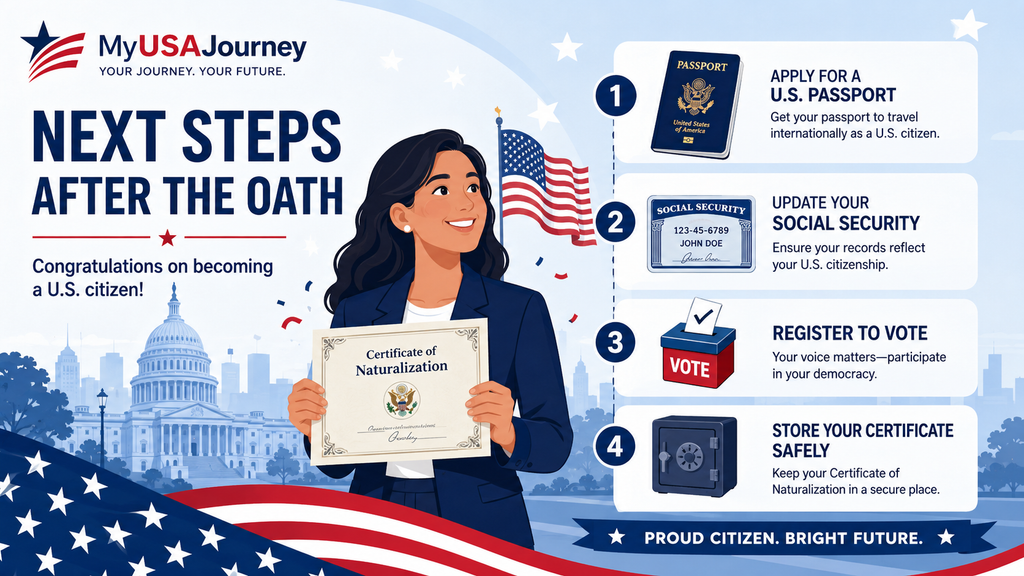
The ceremony is the end of the naturalization process, but it starts several new administrative tasks. The highest-value step is to protect your proof of citizenship and then update the records you actually need.
| After naturalization | Why it matters |
|---|---|
| Review and safeguard the Certificate of Naturalization | It is primary evidence of citizenship and may be needed for passport or record updates. |
| Apply for a U.S. passport | A passport is the normal travel document for U.S. citizens and also serves as strong proof of citizenship. |
| Update Social Security if needed | SSA should have your correct citizenship status and legal name. Some N-400 applicants request this update through the application itself. |
| Register to vote if eligible | Naturalized citizens may register and vote subject to applicable federal, state, and local election rules. |
| Update employer or other records when necessary | Your work authorization no longer depends on permanent-resident status. |
| Store copies securely | Keep high-quality copies for your records while protecting the original certificate. |
How soon can you apply for a U.S. passport after naturalization?
You can begin the passport process after you become a U.S. citizen and have the required evidence. The U.S. Department of State lists a Certificate of Naturalization as primary citizenship evidence for a person born outside the United States.
New citizens applying for a first U.S. passport generally use the first-time passport process, which requires an in-person application. Check the current Department of State instructions for Form DS-11, identification, photo, fees, and processing times before applying.
If international travel is approaching, do not assume that your former Green Card will remain available as a backup travel document—it is normally surrendered at the ceremony. Plan the passport application around your actual travel needs.
Do you need to update Social Security after becoming a citizen?
Your Social Security record should reflect your correct citizenship status. The process has become easier for many N-400 applicants because USCIS and the Social Security Administration allow eligible applicants to request a Social Security record update and, when applicable, a replacement card through information collected on Form N-400.
If you requested this service on the N-400, do not immediately duplicate the request without checking whether it is already being processed. If you did not request it, or if the update does not complete correctly, SSA accepts documents such as a U.S. passport or Certificate of Naturalization as evidence of citizenship, subject to its current identity and document rules.
Can you travel immediately after the oath ceremony?
Be careful. After the oath, you are a U.S. citizen and your Green Card is normally surrendered. International travel should therefore be planned around obtaining the U.S. travel document required for citizens rather than assuming you can continue traveling as a permanent resident.
If you have urgent international travel, review the current Department of State passport-service options before the ceremony and immediately afterward. Passport appointment availability and urgent-travel procedures can change, so use the official State Department website rather than an old forum post.
Can USCIS stop you from taking the oath at check-in?
Yes, if new information means USCIS must review whether you remain eligible. The check-in process is not purely ceremonial. USCIS personnel review the N-445 answers and may update or investigate information before the oath is administered.
This is why truthful disclosure matters. A new event does not necessarily destroy eligibility, but USCIS must be able to assess it. Depending on the issue, the ceremony can be delayed while additional information is reviewed.
If you are worried about something that happened after the interview, do not wait until you are standing in the ceremony line to understand the legal significance. Seek qualified advice beforehand when the issue could materially affect naturalization.
Oath ceremony vs. citizenship interview: the difference
| Naturalization interview | Oath ceremony |
|---|---|
| USCIS reviews Form N-400 and eligibility | USCIS confirms continued eligibility and completes naturalization |
| English and civics testing may occur | No ordinary repeat of the full naturalization test |
| You may receive Form N-652 or a later decision | You use Form N-445 for ceremony instructions |
| Approval may be recommended or granted | You take the Oath of Allegiance |
| You are still a permanent resident | You become a U.S. citizen after taking the oath |
| You normally keep your Green Card | You normally surrender your Green Card |
If your interview is still ahead of you, use our citizenship interview questions guide, our 2026 civics practice test, and our citizenship English test guide to prepare for the earlier stage of the process.
Mistakes to avoid before your naturalization ceremony
- Thinking approval already made you a citizen. For most N-400 applicants, the oath is the final legal step.
- Ignoring Form N-445 until the morning of the ceremony. Read it early enough to gather documents and understand the questions.
- Hiding a post-interview change. Truthful disclosure is safer than creating a new credibility or misrepresentation problem.
- Forgetting the Green Card. USCIS normally collects it at the ceremony.
- Assuming same-day oath is guaranteed. Availability varies.
- Assuming guests can always enter. Venue rules differ.
- Booking immediate international travel without a passport plan. Your immigration status changes at the oath.
- Leaving without checking the Naturalization Certificate. Identify obvious errors as early as possible.
- Ignoring a requested legal name change. A judicial ceremony can affect scheduling.
- Missing the ceremony without contacting USCIS. Follow the N-445 rescheduling procedure.
From Green Card holder to U.S. citizen: the final sequence
- USCIS completes the naturalization interview and testing.
- Your N-400 is approved or recommended for approval.
- USCIS schedules the oath ceremony or, in limited cases, offers same-day oath.
- You receive and review Form N-445.
- You disclose relevant changes since the interview.
- You check in and surrender required immigration documents.
- You take the Oath of Allegiance.
- You receive the Certificate of Naturalization.
- You begin post-naturalization tasks such as passport and Social Security updates.
For the complete process from eligibility through the oath, return to our U.S. citizenship through naturalization guide.
Official sources
- USCIS — Citizenship: What to Expect
- USCIS Policy Manual — Administrative Naturalization Ceremonies
- USCIS — 10 Steps to Naturalization
- USCIS — Overview of the Naturalization Process
- USCIS — Form N-565, Replacement Naturalization/Citizenship Document
- U.S. Department of State — Citizenship Evidence for a Passport
- Social Security Administration — Your Social Security
FAQ: U.S. Citizenship Oath Ceremony 2026
Am I a U.S. citizen as soon as my N-400 is approved?
No. For most naturalization applicants, you become a U.S. citizen only after taking the Oath of Allegiance at a naturalization ceremony.
What is Form N-445?
Form N-445 is the Notice of Naturalization Oath Ceremony. It provides the ceremony date, time and location and includes instructions and a questionnaire about relevant events after your naturalization interview.
What should I bring to my citizenship oath ceremony?
Follow your Form N-445 exactly. Applicants generally bring the N-445, Permanent Resident Card and any USCIS-issued travel or immigration documents that the notice instructs them to surrender, plus any individualized documents requested by USCIS.
Do I have to give USCIS my Green Card at the oath ceremony?
Normally yes. USCIS generally collects the Permanent Resident Card during check-in because you will become a U.S. citizen after taking the oath and will no longer need proof of permanent-resident status.
Can I take the oath on the same day as my citizenship interview?
Sometimes. USCIS says same-day oath may be available in limited circumstances, but it depends on the field office, case approval, ceremony availability and whether a judicial ceremony is required.
How long after the interview is the oath ceremony?
There is no single nationwide waiting period. Timing varies by field office, ceremony and court schedules, name-change requests and case-specific issues. Monitor your USCIS account and official notices.
What if I traveled after my naturalization interview?
Answer the current Form N-445 truthfully and disclose relevant travel as instructed. Travel after the interview does not automatically cancel naturalization, but USCIS must confirm that you remain eligible before administering the oath.
Can family attend a naturalization ceremony?
Many ceremonies permit guests, but seating, security, photography and guest rules vary by venue. Check your N-445 and any field-office, court or venue instructions before making plans.
What happens if I cannot attend my oath ceremony?
Follow the rescheduling instructions on Form N-445 and notify USCIS rather than simply missing the ceremony. You remain a permanent resident until you actually take the Oath of Allegiance.
Can I apply for a U.S. passport after the oath ceremony?
Yes. After naturalization, your Certificate of Naturalization can serve as primary citizenship evidence for a first U.S. passport application. Follow the current Department of State first-time passport instructions.
Why can a name change delay the oath ceremony?
USCIS does not generally have authority to order a legal name change at an administrative ceremony. Applicants seeking a legal name change through naturalization may need a judicial ceremony, which follows the court’s schedule.
Should I update Social Security after naturalization?
Your Social Security record should reflect your U.S. citizenship. Some N-400 applicants request the update through Form N-400; otherwise you may need to work with SSA using acceptable proof such as a U.S. passport or Certificate of Naturalization.